





An interview with Dr. Vlad Kurian, Odesa State Academy of Civil Engineering and Architecture (OSACEA)
by Anastasia Malko
In Odesa, “resilience” is not an abstract concept or a buzzword from urban development plans. It’s a lived reality — a daily practice of adaptation, survival, and care. Architect and educator Vlad Kurian reflects on how war reshapes the idea of a sustainable city, what it means to build amid uncertainty, and how people themselves become the city’s strongest foundation

01 Tairova, Big Fountain, view from west to east, Igor Kalinin
What does “resilience” mean to you today?
If I had to define it simply — it’s the ability of an environment to adapt and recover after a shock. I often translate it as renewability. We used to believe that new buildings meant safety, but the war showed us otherwise. A drone recently hit a brand-new high-rise; it remained standing but severely damaged — and there was no shelter nearby. Strangely enough, some old Soviet panel blocks have proven more resistant.
For me, resilience isn’t just about architecture. It’s about people and cities learning to survive, to rebuild, and to understand their own weaknesses.

02 Destructions in Odesa after attack, 2024-03-02 Source : Wikipedia: Dsns.gov.ua
How does that translate into your design practice?
Lately, my students and I have been rethinking what “safe space” means. We design parks where bomb shelters are integrated into the landscape: during the day, they’re open green lawns; during an alert, they become protection. It’s a forced adaptation, but also an example of architecture responding to real conditions.
Designing like this means thinking not only as an architect but as someone responsible for safety and psychological comfort.

Fig 3. Zhovtiy E.G., OSACEA, ABS-537m(p)Supervisor: PhD, Senior Lecturer Kurian V.V.
How would you describe the state of Odesa’s urban resilience now?
Odesa is holding on, but the urban environment doesn’t always protect us. The city lives under constant pressure. Each attack is not only physical destruction but also a blow to our sense of stability.
There’s no systemic approach to safety here — shelters are created ad hoc, basements are adapted by volunteers, and public spaces are reinforced case by case. The problem is that there’s no citywide resilience policy; it all relies on local initiatives and on people who simply cannot stand still.
You’ve mentioned veterans and people with limited mobility. Why are they central to this idea of resilience?
Because their presence reveals the city’s true level of adaptability. We now have more and more veterans and people with disabilities — and most of them live in old, inaccessible housing. They build their own ramps, install homemade lifts, often in conflict with neighbors because they’re “changing shared space.”
But resilience isn’t only about drones and bombs. It’s about how society deals with vulnerability. A city that ignores its most fragile residents cannot call itself sustainable.
Do you see positive local initiatives emerging?
Yes, but they’re small-scale. There are civic projects improving courtyards, shelters, and green areas — often driven by artists, architects, or local activists. These people act from empathy, not from budgets. Their projects might be modest, but they are deeply human.
That’s where I see true resilience — in small acts of care that hold the city together.
What stands in the way of systemic change?
Two things: war and fear. When someone tries to renovate a park or a courtyard, the reaction is often: “Why are you spending money here when the front needs help?” It’s an understandable emotion. People are exhausted and wary of any change.
And then there’s bureaucracy — endless paperwork and permissions. Many great ideas die before they’re even tested because the system is not designed for flexibility.
What could help Odesa become a more resilient city?
Start small — with dialogue between professionals and residents. We have plenty of ideas but little practical implementation. International exchanges, discussions, urban labs — all of that helps, but resilience grows from everyday gestures.
Someone reinforces a basement, someone adapts a ramp for a neighbor, someone turns an old yard into a community shelter. That’s how real resilience is built — through collective responsibility, not top-down planning.
If you were to draw a portrait of resilient Odesa, what would it look like?
It would be a city held together not by systems, but by people. Odesa is far from perfect, but it’s alive. Every day, someone repairs, adapts, or rebuilds — sometimes clumsily, but always with the belief that life must go on.
Resilience here isn’t a Western urban theory; it’s the ability to turn fear into action. And perhaps that’s why Odesa still stands.
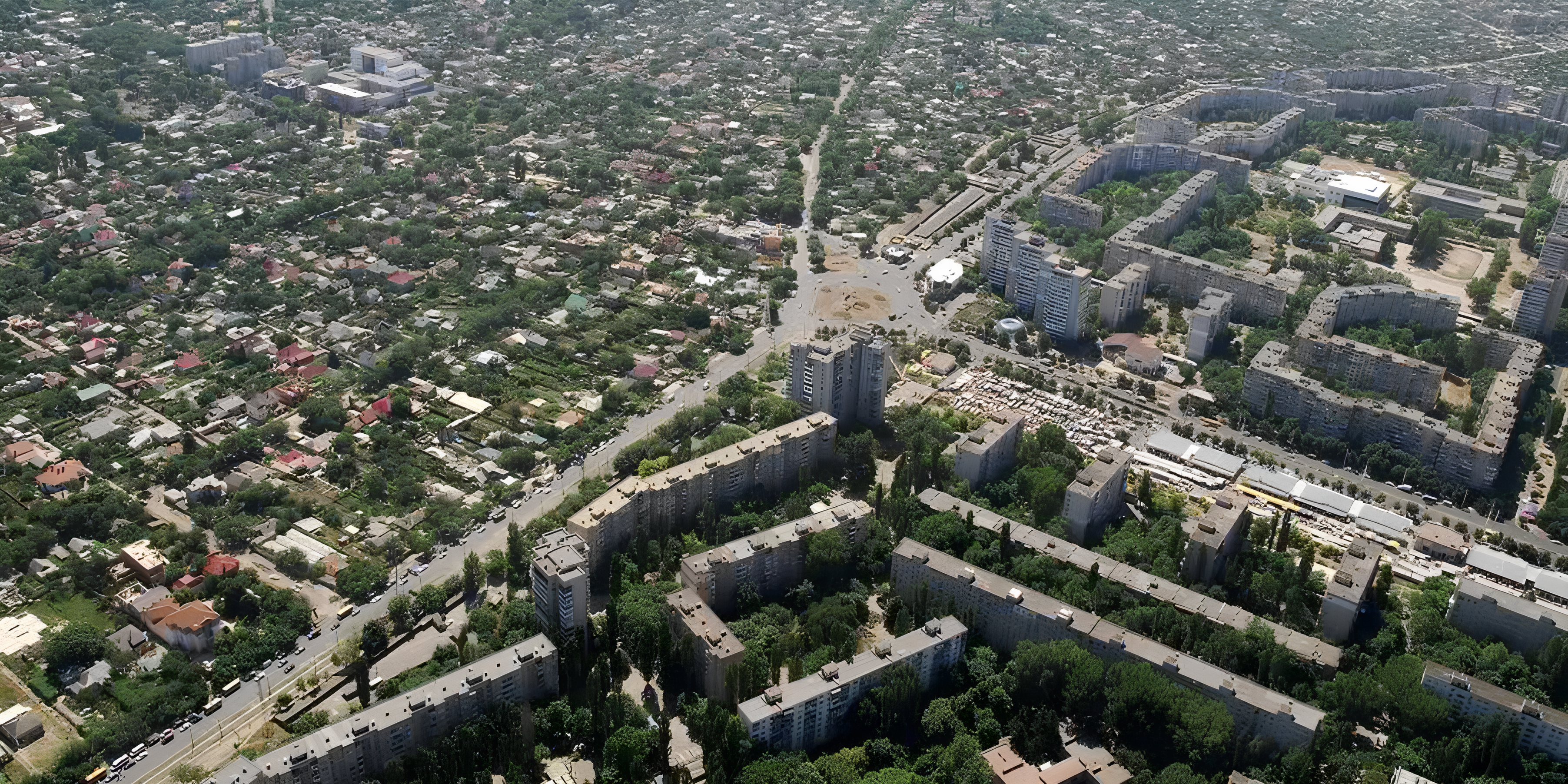
04 The villages of Tairova and Bolshoy Fontan. From left to right stretches Lyustdorfskaya (Black Sea Road), with an intersection with Glushko Avenue and Dolga Street in the middle. Bolshoy Fontan Cape is visible at the top right. Source: Igor Kalinin: